{First Draft, still in review}
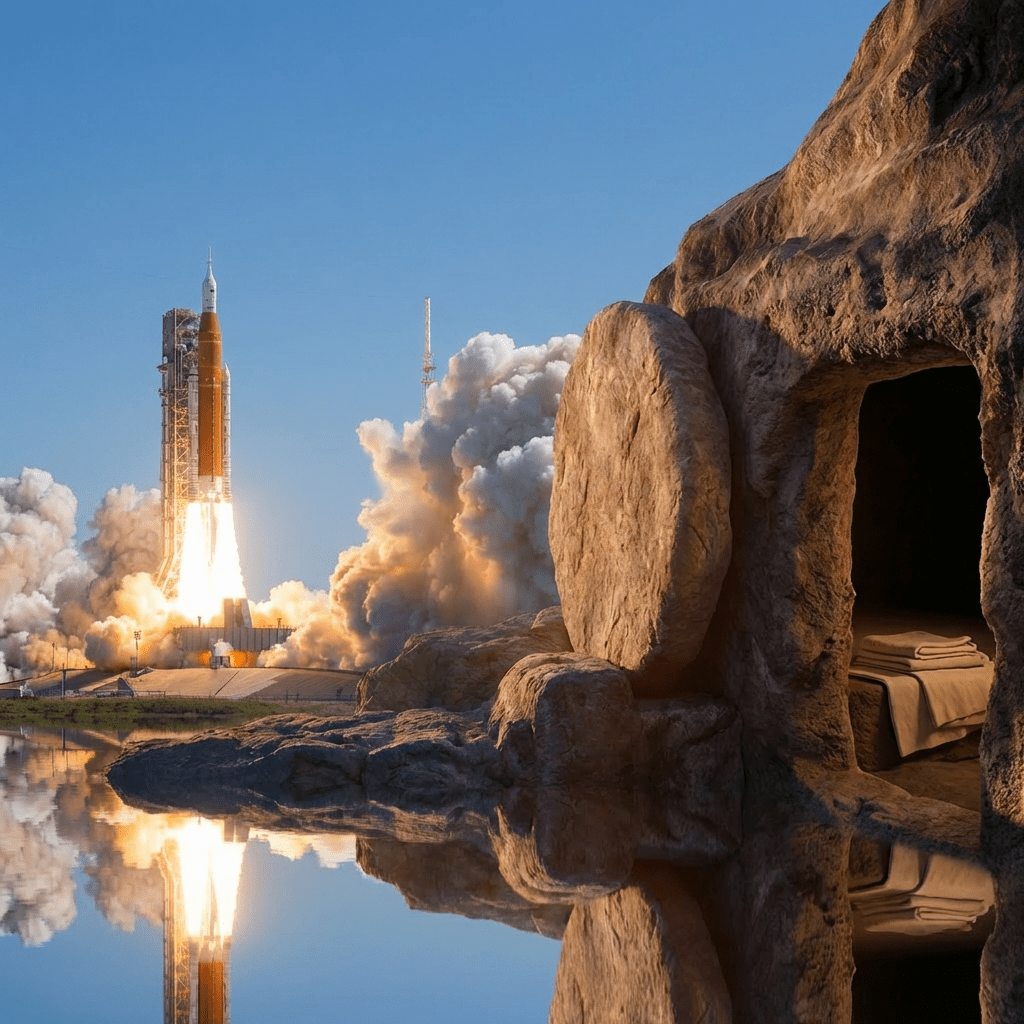
In April 2026, 50 years after the Apollo missions, Artemis II launched 4 human astronauts towards the moon once again. I suppose the “generational mood” is less excited about this than the original Apollo missions, at time when national unity around this great accomplishment made it the most important historical event of the time. In our own era, while the enthusiasm was high for those that follow science and technology, much of the news cycled through the war in Iran, massive leaps in AI, and fractured politics. In the coming days, they will document with unprecedented detail the “dark” side of the moon (the real one, that is always facing away from the earth, not this one). I can’t wait!
I live in Huntsville Alabama, the “Rocket City,” home to engineers, technologists, contractors, and leaders that helped shape this mission from its conception. I went through leadership classes shoulder to shoulder with friends from NASA who fought the budget and technical battles to keep this mission alive in spite of the political mess of our time. Many of my coworkers, neighbors, and friends worked quietly on Artemis before the general public knew anything about it. And even so, within days of the launch, the conspiracy theories about faking the moon landing were back again, this time click-baiting to drive some social media revenue I suppose. I was in the computer graphics industry long before people credibly believed in CGI to fake the moon landing, which was far too complicated for the 1960’s sound stage tech; there is a great video that describes the lighting issues and how we finally got the technology to replicate the famous photos (I remember as a young software developer watching the original graphics product launch video, but could not find it… you know the kind of black-turtleneck product launch hype sessions). I had thought that when MythBusters did their show on the moon landing that would be the end of it. How can people dismiss the reality when a conspiracy of that size is nearly impossible?
In may sound risky, but I will go ahead and say it. Here goes. In spite of the incredible claim, that I cannot easily prove with first person evidence:
I believe that mankind has been to the moon.
Artemis did not spring into existence in a single moment. Fifteen years before launch, small teams at NASA and its contractors were building Artemis on the remnants of earlier programs (Apollo, SLS, Constellation, International Space Station, and more). The Space Program in Huntsville is almost a religion… almost. Then came the focused growth for another moon-shot: engineers in Huntsville, software teams in Houston, manufacturing in Louisiana, testing in Florida, suppliers across dozens of states, and international partners abroad. We all knew it was a necessary step towards an eventual trip to Mars, this time we are going to the Moon for a much longer visit. Eventually, by the time the public began to notice Artemis, tens of thousands of people had already touched the project. When we got to launch day, well over 100,000 people had participated in some significant way.
To believe Artemis is a hoax, one must believe that an army of ordinary people maintained a perfect deception for more than a decade. Engineers, welders, accountants, military personnel, managers, astronauts, suppliers, and foreign observers would all have to remain silent. No serious confession. No credible collapse. No leak sufficient to expose the fraud.
It is an incredible event, to be sure. What an interesting word: incredible. The word “incredible” is pure irony. Its Latin root, credibilis, means “worthy of belief,” while the prefix [in] ordinarily negates it: something incredible should mean “not credible,” something beyond belief in the sense of unbelievable or implausible. Yet over time the word acquired a second, almost opposite meaning. We now call something “incredible” not when it is false, but when it is so extraordinary, so astonishing, that ordinary categories seem inadequate. An incredible achievement is not one lacking evidence; it is one whose greatness strains our ability to believe it. The Moon landing was incredible in precisely this sense.
So also is the resurrection incredible. This past Sunday, while the astronauts were propelling towards the moon, nearly a third of the humans on Earth celebrated another incredible event recorded as having occurred 2 thousand years ago. Can this kind of faith be credible? The difficulty is that we often confuse “hard to believe” with “not worthy of belief.” But the greatest events in history are often both: beyond what we expected, yet supported by evidence that compels us to reckon with them.
The greater the number of people involved, the less plausible the conspiracy becomes. Let’s be engineers about it and build a table, shall we? Imagine the number of scientists, leaders, engineers, and analysts involved in Artemis that would need to be involved to make a conspiracy work.
Click to Expand [Table of Artemis Program Involvement from T minus 15 years until launch]
| Relative Year | Calendar Year | Major Artemis Phase | What Was Happening | Approx. People Involved* |
|---|---|---|---|---|
| T-15y | 2011 | Post-Constellation Transition | NASA salvages the core elements of the canceled Constellation program—Orion and the early Space Launch System concepts—into a new deep-space architecture. Small internal NASA teams and a few major contractors continue work quietly. | 2,000–3,000 |
| T-14y | 2012 | Exploration Mission-1 Defined | NASA formally outlines what would later become Artemis I (then EM-1). Early design work begins on Orion, SLS, and mission architecture. | 3,000–5,000 |
| T-13y | 2013 | Orion Service Module / Internationalization | NASA and ESA agree to develop the European Service Module. Orion, SLS, and supporting systems begin to grow into a broader international program. | 5,000–7,000 |
| T-12y | 2014 | Hardware Fabrication Begins | Construction begins on major SLS hardware at Michoud and Marshall. Early Exploration Ground Systems work starts at Kennedy Space Center. | 8,000–10,000 |
| T-11y | 2015 | Major Contractor Ramp-Up | Boeing, Lockheed Martin, Northrop Grumman, Aerojet Rocketdyne, Jacobs, and dozens of subcontractors expand staffing. Test articles, software, avionics, and facilities development accelerate. | 12,000–15,000 |
| T-10y | 2016 | Integrated Program Growth | SLS, Orion, and ground systems become a national industrial effort. Huntsville, Houston, Florida, New Orleans, Utah, Colorado, and California are all deeply engaged, though most Americans remain unaware of the scale. | 20,000–25,000 |
| T-9y | 2017 | Artemis Vision Revived | The lunar return mission is revived and refocused under the new administration. NASA is directed back toward the Moon, building upon the years of prior work already underway. | 25,000–35,000 |
| T-8y | 2018 | “Artemis” Takes Shape | The Artemis name and long-term mission architecture emerge publicly. Additional contractors, suppliers, universities, and support organizations are brought into the effort. | 35,000–50,000 |
| T-7y | 2019 | Accelerated Lunar Landing Goal | NASA announces the initial Artemis I / II / III sequence and an aggressive lunar return schedule. Workforce expands dramatically as development, testing, and launch preparation intensify. | 50,000–70,000 |
| T-6y | 2020 | Pandemic and Distributed Development | COVID slows schedules but does not stop the program. Thousands continue working across NASA centers, factories, suppliers, software teams, and mission operations. | 60,000–80,000 |
| T-5y | 2021 | Lunar Lander and Artemis Expansion | NASA selects commercial lunar lander partners, especially SpaceX, while Artemis broadens beyond SLS and Orion into a full Moon-to-Mars ecosystem. | 80,000–100,000 |
| T-4y | 2022 | Artemis I Launch Preparation and Flight | Final integration, testing, launch operations, and mission support peak around Artemis I. Hundreds of companies and tens of thousands of people are now involved directly or indirectly. Artemis I launches successfully in November 2022. | 100,000–120,000 |
| T-3y | 2023 | Artemis II Crew and Long-Lead Production | NASA names the Artemis II crew and begins full preparation for the first crewed lunar mission. Production of later mission hardware continues simultaneously. | 110,000–130,000 |
| T-2y | 2024 | Final Testing and Launch Readiness | Orion, SLS, ground systems, software, launch infrastructure, and crew procedures are tested repeatedly. Exploration Ground Systems alone receives billions in support and involves thousands of workers. | 120,000–140,000 |
| T-1y | 2025 | Integrated Countdown Year | The public begins to notice Artemis II, but by now the work has already involved over a decade of effort. Launch rehearsals, crew training, mission simulations, and final hardware integration occur. | 130,000–150,000 |
| T-0 | 2026 | Artemis II Launch | Artemis II launches after fifteen years of development rooted in even earlier Constellation-era work. Tens of thousands of people directly support the mission, while the broader industrial base reaches into the hundreds of thousands. | 150,000+ |
*These estimates are intended to illustrate the growing scale of the program, including NASA civil servants, major aerospace contractors, subcontractors, suppliers, software teams, university researchers, military support, international partners, and ground operations personnel. By Artemis II, the true number of people touched by the effort likely approaches the scale of Apollo, which at its peak involved over 400,000 people nationwide.
You know, I walked with engineers throughout Huntsville that were talking about the legacy space program vs the new Artemis program and was tracking doubt as well. In fact, one of my fellow Huntsvillans, Destin Sandlin from Smarter Every Day, gave a “talky-talk” for the local space folks about Artemis a couple of years ago; this was well before the main population really knew about the program but still very far into the engineering phases when most of the data was available (and thousands of people had their careers invested into the program). This is what people who really care about getting the truth do, instead of creating conspiracy theories to discredit people who know, they work to dig into the data and understand. Researching doubts is critically important to getting to the truth.
That same principle applies, perhaps even more strongly, to Easter. Matthew records a curious sentence, one of the most vulnerable and honest statements in all of recorded history, that after the resurrection it was not just bliss and obedience. There was serious doubt about not only what had just happened but how to deal with the ramifications of this new experience:
“And when they saw him they worshiped him, but some doubted.” — Matthew 28:17
Think about Huntsville and Artemis much like Jerusalem was for the early followers of Christ; these were people that knew what was going on before the rest of the world was involved. We have all heard about “doubting Thomas” yet let’s be honest, everyone was really concerned about how to mentally process what they witnessed. He was just bold enough to say what everyone else in the room was thinking. From that group of disempowered and scattered followers of a guy that just got capital punishment, disenfranchised by the Jerusalem establishment and having no possibility of taking on Rome, you have a movement that literally reshaped the known world. So what does it look like to have converted doubters across the entire Roman Empire such that it became the dominant worldview? Let’s build another table!
Click to Expand [Table of the Spread of Christianity from Crucifixion until the Publication]
| Year | Relative Date | Major Event / Phase | Geographic Scope | Approximate Size of the Church** |
|---|---|---|---|---|
| AD 30 | T+0y | Resurrection, Ascension, Pentecost. About 120 disciples gathered in Jerusalem before Pentecost. | Jerusalem | About 500 |
| AD 30 | T+0y | Pentecost: about 3,000 baptized after Peter’s sermon. The church begins meeting publicly and house-to-house. | Jerusalem | 3,000–3,500 |
| AD 31 | T+1y | Continued growth in Jerusalem; Acts records the number of men alone rising to about 5,000. Including women and families, the movement is substantially larger. | Jerusalem and Judea | 8,000–12,000 |
| AD 33 | T+3y | Stephen is martyred. Persecution scatters believers into Judea and Samaria. Philip preaches in Samaria and to the Ethiopian official. | Judea, Samaria, Gaza road | 10,000–15,000 |
| AD 34 | T+4y | Saul’s conversion. Small Christian communities now exist outside Jerusalem in Damascus and nearby regions. | Jerusalem, Damascus, Syria | 12,000–18,000 |
| AD 37 | T+7y | Peter visits Lydda, Joppa, and Caesarea. Cornelius becomes the first major Gentile convert. The church begins to expand beyond Judaism. | Judea, Caesarea, coastal Palestine | 15,000–20,000 |
| AD 40 | T+10y | Antioch becomes a major center. Followers of Jesus are first called “Christians.” Missionary work now reaches Greek-speaking Gentiles. | Syria, Antioch, Cyprus | 20,000–30,000 |
| AD 46 | T+16y | Paul’s first missionary journey with Barnabas. Churches established in Cyprus and southern Asia Minor. | Cyprus, Galatia, Asia Minor | 30,000–40,000 |
| AD 49 | T+19y | Jerusalem Council resolves that Gentile converts need not become Jews. This dramatically accelerates expansion. | Jerusalem, Antioch, Asia Minor | 40,000–50,000 |
| AD 50 | T+20y | Paul’s second missionary journey. Churches planted in Philippi, Thessalonica, Berea, Corinth, and elsewhere in Greece. | Macedonia and Greece | 50,000–70,000 |
| AD 53 | T+23y | Paul’s third missionary journey. Ephesus becomes a major hub; Acts says “all Asia” heard the word through the Ephesian ministry. | Asia Minor, Greece, Aegean world | 70,000–90,000 |
| AD 57 | T+27y | Paul returns to Jerusalem and is arrested. By now churches exist in most major eastern cities of the Roman Empire. | Judea, Syria, Asia Minor, Greece, Rome | 90,000–120,000 |
| AD 60 | T+30y | Paul arrives in Rome under house arrest. Christianity is now present in Rome, Egypt, Syria, Asia Minor, Greece, and perhaps farther east. | Much of the Roman Empire | 100,000–150,000 |
| AD 62 | T+32y | Book of Acts ends with Paul preaching freely in Rome. The church is still illegal and often obscure, yet it has spread across the empire in a single generation. | Empire-wide urban network | 120,000–180,000 |
| AD 64 | T+34y | Neronian persecution begins after the Great Fire of Rome. Peter and Paul are believed to be executed shortly afterward. | Rome and beyond | 150,000–200,000 |
**These figures are necessarily approximate, but they illustrate the same pattern as the Artemis program: long before the average Roman citizen knew much about Christianity, thousands of people across cities, cultures, trade routes, and languages had already become part of the movement.
By the time the book of Acts is written, Christianity is no longer a rumor in Jerusalem. It has become an interconnected network of churches stretching from Jerusalem to Rome, with hundreds of local congregations, numerous written letters already circulating, and many thousands of eyewitness-linked believers across the empire. Estimates by historians such as Rodney Stark and Bart Ehrman generally place the Christian population around 100,000–150,000 by AD 60, growing to perhaps 150,000–200,000 by the mid-60s.
That is not the sort of line one invents in a legend. A fabricated story removes uncertainty. It makes every witness immediately certain, brave, and triumphant. The Gospels show frightened disciples, confused women, skeptical followers, a denying Peter, a doubting Thomas, and even group that doubted and needed to double down to check their beliefs against the new reality.
The Bible is not embarrassed by doubt. It simply refuses to make doubt the final word. In fact, the very existence of the New Testament is a marvel from the perspective of ancient literature. Consider that most major events of human history have been attested to by only a handful of people. Don’t believe me? How about yet another table (you probably are getting a data oriented vibe here, right?)
Click to Expand [Documentation of Ancient Events by Eyewitnesses]
| Event | Principal Authors | Approximate Date of Writing | ^Distance from Event |
|---|---|---|---|
| Peloponnesian War | Thucydides | Began writing during the war, c. 431-400 BC | T+0-30y |
| Peloponnesian War | Xenophon | c. 390-360 BC | T+14-44y |
| Alexander the Great’s conquests | Callisthenes | During Alexander’s campaigns, c. 330s BC (lost) | T+0-5y |
| Alexander the Great’s conquests | Arrian | c. AD 110-130 | T+440-460y |
| Alexander the Great’s conquests | Plutarch | c. AD 100-120 | T+420-440y |
| Julius Caesar’s Gallic Wars | Julius Caesar | c. 52-51 BC | T+0-6y |
| Assassination of Julius Caesar | Nicolaus of Damascus | c. 20 BC-AD 10 | T+35-55y |
| Assassination of Julius Caesar | Suetonius | c. AD 120 | T+160y |
| Assassination of Julius Caesar | Plutarch | c. AD 100-120 | T+145-165y |
| Eruption of Mount Vesuvius in 79 AD | Pliny the Younger | c. AD 104-107 | T+25-28y |
| Fall of Jerusalem | Josephus | c. AD 75-79 | T+5-9y |
| Eyewitness of Jesus | Paul the Apostle | Earliest letters c. AD 48-67 | T+15-37y |
| Eyewitness of Jesus | Peter the Apostle | Letters written prior to death c. AD 50-64 | T+17-34y |
| Eyewitness of Jesus | James the Brother of Jesus | c. AD 45-48 | T+12-18y |
| Eyewitness of Jesus | Jude the Brother of Jesus | c. AD 60-90 | T+30-60y |
| Eyewitness of Jesus | Mark the Student of Peter | c. AD 50-65 | T+20-35y |
| Eyewitness of Jesus | Matthew the Apostle | c. AD 55-65 | T+25-35y |
| Eyewitness of Jesus | Luke the Evangelist, Student of Paul | c. AD 60-62 | T+30-32y |
| Eyewitness of Jesus | John the Apostle | c. AD 85-95 | T+55-65y |
^The comparison is striking: for many major events of antiquity, historians consider sources written decades or even centuries later to be entirely respectable. By contrast, the central events of Christianity were documented by multiple authors within the lifetime of eyewitnesses, many within 15–35 years of the resurrection, while hostile witnesses and contemporaries were still alive.
I obviously summarized only a handful of the many events and writings of ancient history here, wanting to focus on a couple of major personalities and events that we have strong confidence about (e.g. Alexander the Great and Julius Caesar). Let’s start by saying that the person of Jesus is in no dispute; it still makes magazines sell at the checkout counter of the grocery store (yes, they still have those) and it still makes click-bait on social media, but no serious scholar debates the existence of the person. When it comes to the events of New Testament, not just the “mythical figure”, it has been so well analyzed we can even identify specific passages that may be in error! We do not need to question even the individual sayings of Jesus because we can focus in on a very specific phrase to question, much less the whole individual letter or book. I gave a presentation to a group of college students in 2014 that walked through the literary evidence of the cannon and an example of this kind of attention to detail… in this case a disputed passage of Scripture. I suppose one of these days I will make it a blog post, but here are the slides from that presentation. The point is that even among the best-documented events of antiquity, the norm is one principal eyewitness source. Two is unusual. Most of the major events (e.g. assassination of Caesar) are not even made by eyewitnesses but rather by some historian a full generation or more later after the events occurred.
This makes the New Testament documentation record astounding! A network of six to eight interconnected authors writing within a generation is extraordinarily rare; unlike what you have in the New Testament with Matthew, John, Peter through Mark, Luke, Paul, James, Jude, and their named associates, most of the events of the ancient world are, by comparison, little more than hearsay. The resurrection was not proclaimed by one isolated man with a private vision. It is perhaps the most well documented event (prior to the invention of the printing press) in all of ancient history. It emerged in the very city where Jesus had been crucified only weeks before. The tomb was in a known location. The authorities were present. The hostile anti-witnesses were still alive.
However, there is another layer to the comparison. Artemis required thousands of people to build a spacecraft, but the largest risks to them were career or credibility. Christianity required thousands of people to embrace a scandal. The first Christians did not gain power, wealth, or comfort by proclaiming the resurrection. They did not simply hold those things at risk, they actually lost them. Lives were at stake for proclaiming “Jesus is Lord” (and, therefore, not Caesar). The whole point of the Roman persecution was to make the cost of Discipleship too extreme and to thus stamp out the movement. They had lots of experience doing exactly that, so the advent of Christianity is more than just documentation about a unique and incredible event, it is an anomaly of another kind entirely. The apostles were beaten, imprisoned, and eventually killed. Priests who believed in Christ lose their place in the temple. Merchants risked their businesses. Roman soldiers risked their lives. Public officials risked their standing. Families risked rejection. Christians in Rome eventually faced torture and execution.
If an engineer today knowingly lied about Artemis, he might lose his job or face a lawsuit. The first Christians, by contrast, faced prison, ruin, and death. Some men may die for a lie if they think it is true. But men do not willingly die for what they know to be false. It is one thing to believe a conspiracy, it is quite another to create one worth risking your life to convince others about.
The resurrection accounts are especially remarkable because they were written so early. Most events in the ancient world are known from one author writing decades or even centuries later. Alexander the Great is known chiefly through writers who lived more than four hundred years after him. Julius Caesar’s assassination is described largely by authors writing more than a century afterward. The resurrection is so very different.
Within fifteen to thirty years of the event, Paul was writing letters to churches throughout the empire. James, the brother of Jesus, wrote while many eyewitnesses were still alive. Matthew, Mark, Luke, and John all recorded the story within the lifetime of those who had seen these things. Peter’s testimony stood behind Mark. Luke carefully gathered eyewitness accounts. John wrote as one who had leaned upon Jesus Himself.
More striking still, these writers were not strangers to one another. They formed an interconnected network. They traveled together, suffered together, and sometimes wrote together. Paul named his secretaries and companions. Luke accompanied Paul. Mark worked with Peter. Silvanus assisted Peter. The authors were not scattered voices inventing isolated myths. They were a community of witnesses.
And what did they all say? It is best captured in a creed that they spoke to one another in the earliest days after the resurrection, before even the first letters were written, and captured in 1 Cor 15:3-8.
- That the Old Testament Jewish Scriptures were prophetic of the events.
- That Jesus a human that was crucified and died.
- That He was buried.
- That He rose again.
- That He appeared to many who were eyewitnesses.
The theology did not emerge slowly over centuries. It arrived with astonishing speed. Within weeks of the crucifixion, persecuted eyewitnesses were already proclaiming that Jesus was the risen Son of God. Within just a couple of years it had spread beyond Jerusalem and people all over Rome were worshiping Him, reciting creeds that still survive in Paul’s letters. Today there are modern tools that can provide “deep fakes” and so it helps to be a bit skeptical. Just remember, you cannot deep fake the past. Perhaps that is why God elected to create the explosion of literary proof and then build up the evidence over two thousand years by skeptical analysis (folks like me that did not take it at face value and did our research) about Jesus. If you saw it on TV, would you believe it any more than reading about it from history? While you are watching events of our lifetime unfold in space, beyond what you can touch or see with your own eyes, you are relying on technology and eyewitness accounts.
This is what makes the resurrection so difficult for some people to accept. The evidence is not weak, though thoughtful skepticism is warranted; however, the implications are enormous so it is worth doing some homework on your own.
Discussion Outline: [Hosting a Theology Pub]
Theology Pub on Incredible Doubts and Credible Evidence
Let’s assume that you are going to grab coffee, lunch, or a drink after work with some friends who do not live under a rock and know about the Artemis mission. Would you talk to them about something like this? Here are some sample questions that you could use as conversation starters:
- If you had lived in Jerusalem in AD 30, or at Cape Canaveral this week, what would it have taken to persuade you of incredible news? Do you really believe we put a man on the moon?
- Why do people doubt extraordinary events even when evidence is abundant? Talk about the nature of personal skepticism and why it is important to fill in the gaps, to ask tough questions, and why doubt is not the same as disbelief.
- What is the difference between healthy skepticism and determined unbelief? Talk about what makes the difference between acknowledging evidence and rejecting the implications of a belief.
- Does the existence of doubt prove anything about the truth of an event? The whole process of learning requires us to ask questions and challenge assumptions, so doubt can be very healthy; however, having questions should not cause us to toss out the evidence that is available to us.
Discussion Points
1. The Scale of a Conspiracy
Talk about the need to maintain a consistent story if you are trying to fabricate an incredible event. What would the motivations be and who would benefit or be at risk from the conspiracy? A small lie can be maintained by one person, so we can see “snake oil salesman” type followings that quickly come and go. A larger lie perhaps by a handful, so we can see really impactful lies like Watergate happen but then collapse when just one person gets caught in the lie. However, what kind of scale would it take to create a conspiracy when thousands of people are involved? Talk about the likelihood of maintaining a deception when persecution collapses all the incentives for maintaining the conspiracy.
- Artemis involved over a decade of work and more than 100,000 people. What did they risk for hiding anything that could have contributed to a potential mission success or failure? What if they had political pressure to “make a launch happen” even if they knew something would fail, could they all reasonably be kept quiet on launch day?
- The early church grew from 120 believers to perhaps 100,000 across the Roman Empire in a generation. Talk about the risk to their lives and reputations for even entertaining the idea that a dead Jewish man was greater than Caesar.
- Thousands claimed to know someone who had seen the risen Christ. Compare the evidence for belief in Jesus by the first century people who could talk to eyewitnesses with the first-hand videos of the launch of Artemis, the ability to travel to Huntsville and see where work was done, and the level of detail that is captured about these events. There is a lot of information to explore! Can anyone name an ancient event that is captured with that level of detail apart from the resurrection of Jesus?
Which is more difficult to believe: that Christ rose from the dead, or that thousands of people knowingly maintained the same lie while suffering for it?
2. Extraordinary Events Produce Extraordinary Doubt
The Moon landing and the resurrection share something in common: both are so extraordinary that they offend our instincts. You cannot prove the moon landing without help from scientists and engineers that (if you believe it to be a conspiracy) would have also been complicit in making up the story to begin with. However, the implications are very different: if we landed on the moon then, well, so what? However, the resurrection challenges the belief that death is final and the universe is only material, so the stakes are much higher for an individual confession.
Why is it often easier to believe a the evidence for Christianity is a vast conspiracy than an uncomfortable truth?
3. The Nature of the Witnesses
The first witnesses to the resurrection were not gullible enthusiasts, they risked everything to proclaim what they saw. They were also honest about their doubts and scripture records some inconvenience in any formation of hero stories:
- Thomas doubted.
- Peter denied Christ.
- The women were not initially believed.
- The disciples hid in fear and were heavily persecuted.
These are not the ingredients of propaganda. They are the marks of honest testimony.
What makes a witness credible? Can a good “cross examination” create fear and doubt? If so (and the answer is most certainly yes) then what explanation do we have that Rome simply could not stomp out this obscure belief in the resurrection of Jesus?
4. The Cost of Belief
Beyond the initial eyewitnesses, something else astonishing happened: belief in Christ spread throughout the entire Roman world. Something in the evidence, message, and transformation of their lives caused a massive group of people to accept something that was scorned by Rome and could not be silenced from a place that was not even their own home town. It was one thing for people in Huntsville to believe in the moon landing, we have rockets to spare (seriously, you can even see one at the rest stop nearby). However, it spread within a single generation far beyond the city of origin to every part of the Roman Empire. much too fast for a myth because you could still go see and interview the eyewitnesses. Even so, proclamation of believe had crushing side effects. The first Christians gained almost nothing from proclaiming Christ and lost almost everything.
- Apostles were imprisoned and killed.
- Business owners lost trade, especially when it was partially dependent on local idols.
- Religious folks, especially priests, lost status with their family and community.
- Roman officials risked careers, soldiers especially were among the early Christian converts after they had been persecutors!
Men will sometimes die for a lie they believe to be true. But they do not die for a lie they know to be false.
What possible motive could explain the persistence of the first Christians if they knew the resurrection never happened?

 Theology Pub
Leave a comment